
For adult children helping an aging parent
The Care Decision Flow
You're the one who noticed. Now you have to work out what your mother or father actually needs, what it costs, and how long the money lasts, usually alongside siblings who don't all agree on what to do.
Most of this is arithmetic, not judgment. This free three-page guide turns it into four questions with real answers, which most families can settle in about two weeks, so the one real decision rests on facts.
Free · 3-page PDF
Get the Care Decision Flow
Tell us where to find you and the download opens right here.
What's inside
- The four questions with real answers: what your parent wants, what they need, what it costs and how long the money lasts
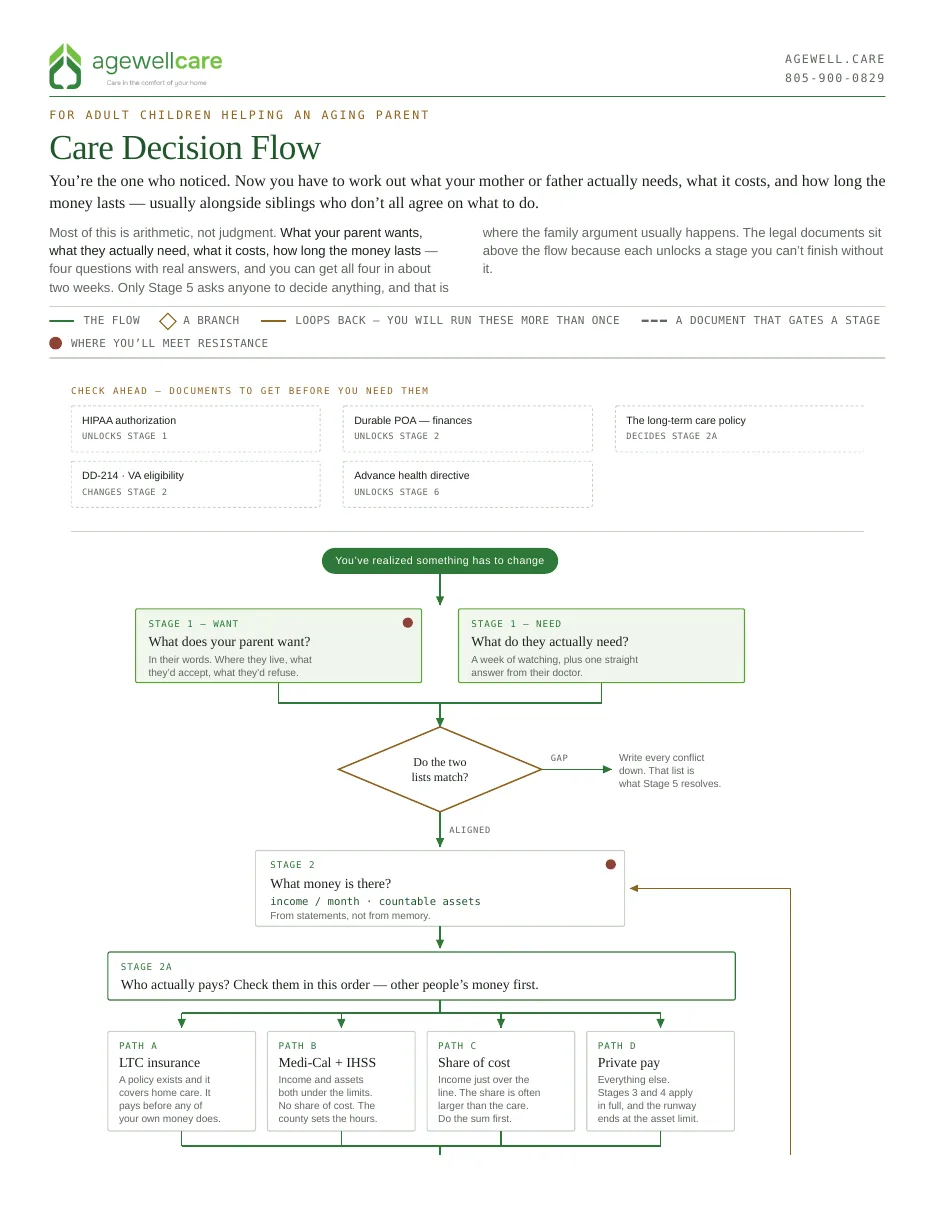
- The five documents to get before you need them, and the stage each one unlocks
- Who actually pays: long-term care insurance, Medi-Cal and IHSS, share of cost, or private pay
- The simple sum that shows how many months of care the money covers
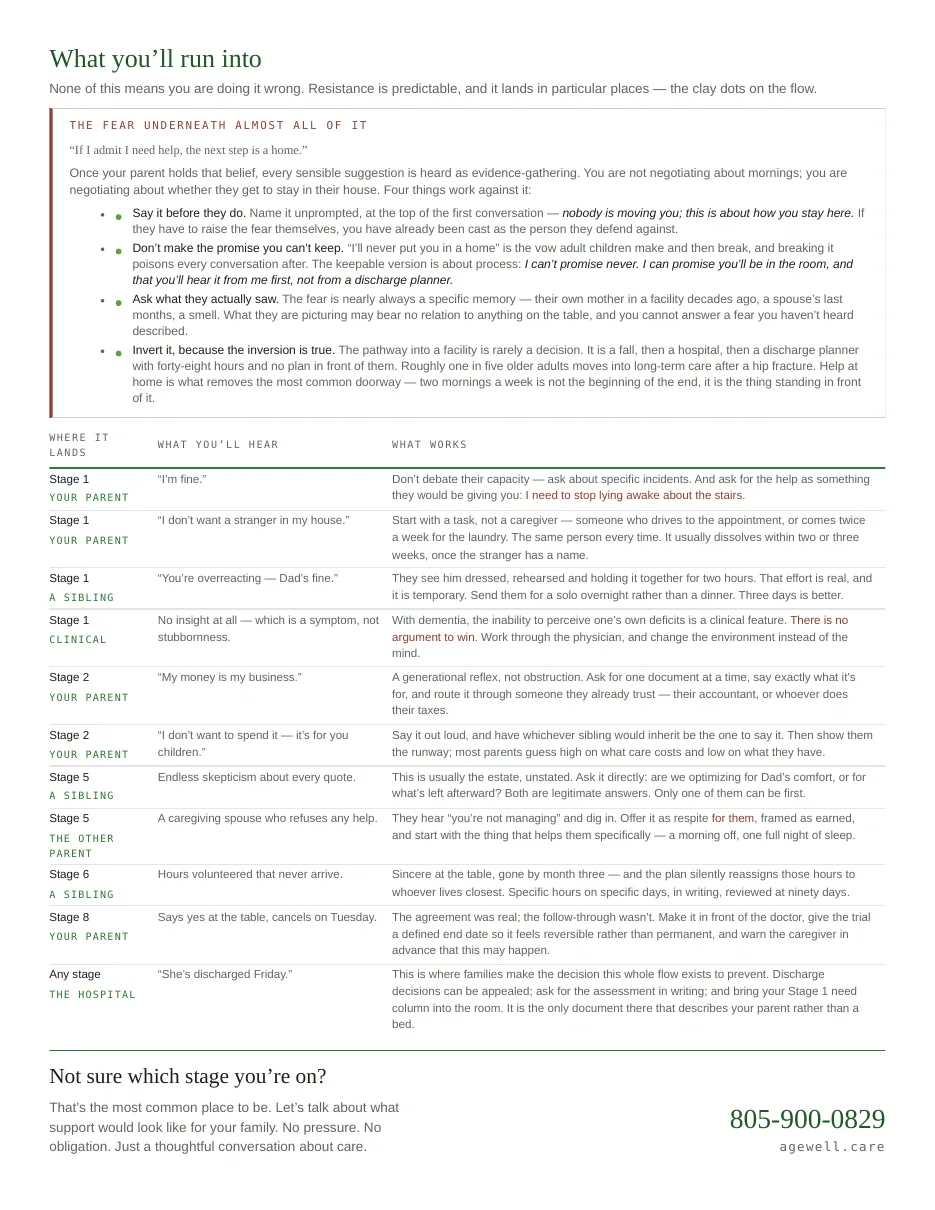
- What parents and siblings tend to say at each stage, and what works
A look inside
Three pages, start to finish
The flow at a glance
Eight stages, one number
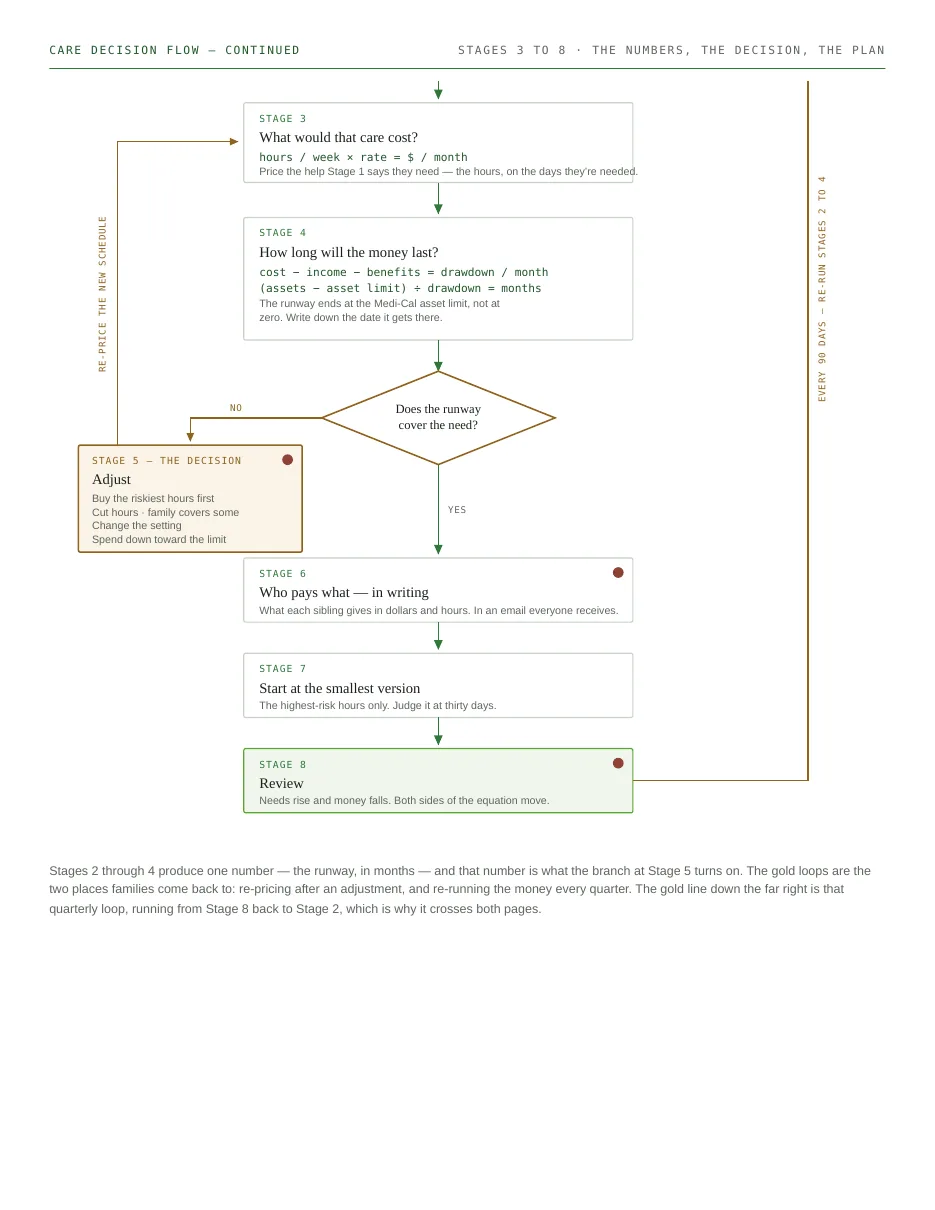
Stages 2 through 4 produce a single number: the runway, in months. That number is what the family decision at Stage 5 turns on.
Documents to get before you need them
- HIPAA authorizationUnlocks Stage 1
- Durable POA for financesUnlocks Stage 2
- The long-term care policyDecides Stage 2A
- DD-214 and VA eligibilityChanges Stage 2
- Advance health directiveUnlocks Stage 6
- 1
Want and need
What your parent wants, in their words, set beside what a week of watching and their doctor say they need.
- 2
The money
Monthly income and countable assets, taken from statements rather than memory.
- 2A
Who pays
Other people's money first: a long-term care policy, Medi-Cal and IHSS, share of cost, then private pay.
- 3
The cost
Hours per week times the rate, priced for the help Stage 1 says is needed.
- 4
The runway
How many months the money lasts, measured to the Medi-Cal asset limit rather than to zero.
- 5
The decision
If the runway falls short: cover the riskiest hours first, share hours with family, or change the setting.
- 6
In writing
What each sibling gives in dollars and hours, in one email everyone receives.
- 7
Start small
Begin with the highest-risk hours only and judge it at thirty days.
- 8
Review
Needs rise and money falls, so run the numbers again every quarter.
The fear underneath almost all of it
"If I admit I need help, the next step is a home."
The guide shows how to answer that fear honestly. The usual path into a facility is not a decision. It is a fall, then a hospital, then a discharge planner with forty-eight hours and no plan. Help at home is what keeps that door closed, so your parent can keep living independently in the house they know.
Get the free guideNot sure which stage you're on?
That's the most common place to be. Let's talk about what support would look like for your family. No pressure, no obligation, just a thoughtful conversation about care.
Working out Stage 2A? See home care pricing and insurance, using long-term care insurance or the in-home care guide.